
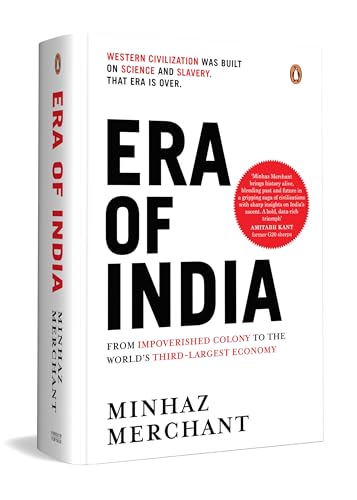
Era of India : From impoverished colony to the world's third-largest economy
Publication details: Gurugram: Penguin, 2026. Description: XIV, 501pISBN:- 9780143478478
| Cover image | Item type | Current library | Home library | Collection | Shelving location | Call number | Materials specified | Vol info | URL | Copy number | Status | Notes | Date due | Barcode | Item holds | Item hold queue priority | Course reserves | |
|---|---|---|---|---|---|---|---|---|---|---|---|---|---|---|---|---|---|---|
 Books
Books
|
Main Library (First Floor, Rack No.04) | 320 MER (Browse shelf(Opens below)) | Available | Recommended by AKHIL C (DPM/19/09/H) | 38476 |
Book One
1. An Unfolding Era
2. Great Powers
3. Wealth of the West
Book Two
4. Civilizations, Old and New
5. The Golden Age
6. The Saxons
7. Crescent and Sword
8. New Worlds
9. Age of Enlightenment?
10. Colonial Conquest
11. The Great Drain
12. The English Assault
13. America's Slavery Debt
14. Case for Reparations
15. The Great Divergence
16. America's Rise
17. Debt and Dishonour
18. Fatal Australia
19. England's German Gene
20. Fighting Europe's Wars
21. A Question of Race
22. Blacklash in America
23. An Unfolding Contest
24. Devil's Island
25. Africa, the Future
Book Three
26. Fall of the West
27. Rise of the Rest
28. Chinese Conundrum
29. pacific Challenge
30. The Cost of Independence
31. Soft Power
32. Anglosphere, Future Imperfect
33. 2025-50
In his narrative-defining book, Era of India, Minhaz Merchant examines interlinked civilizational arcs across centuries and millennia. Through much of recorded history, living standards were broadly similar in the Old World: Europe, Asia and Africa.
The discovery of the New World in the Americas and Australasia brought about great change: catastrophic for some, a boon for others. Differences in per capita income between Europeans and Asians were minimal in 1600. By 1900, the gap had risen multiple times. Europe emerged from plague and penury to great wealth.
Was this extraordinary turn of events due to scientific discoveries, the Industrial Revolution and technological innovation? Or did centuries of exploitative, invasive colonialism, the 250-year-long transatlantic slave trade from Africa to the Americas, and colonist-settlements in the New World result in the largest transfer in history of wealth from East to West? Crucially, is it time for the West to pay reparations for three centuries of extra-territorial colonial conquest and enslavement?
Using empirical data and deeply researched documented evidence, Minhaz Merchant answers these questions in a riveting narrative that examines how the rise of India from an impoverished British colony in 1947 to the world’s third largest economy by 2030 will reshape the world order in the next quarter century
There are no comments on this title.
