
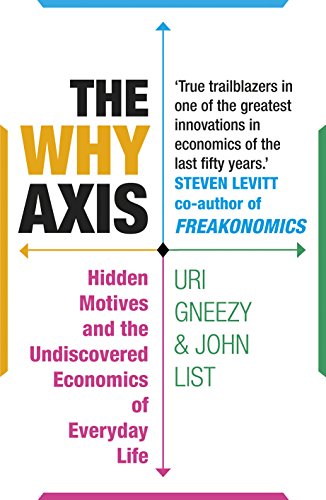
The why axis
Publication details: London: Random house, 2013. Description: 267pISBN:- 9781847946751
| Cover image | Item type | Current library | Home library | Collection | Shelving location | Call number | Materials specified | Vol info | URL | Copy number | Status | Notes | Date due | Barcode | Item holds | Item hold queue priority | Course reserves | |
|---|---|---|---|---|---|---|---|---|---|---|---|---|---|---|---|---|---|---|
 Books
Books
|
Main Library (First Floor, Rack No.06) | 330.019 GNE (Browse shelf(Opens below)) | Checked out | Recommended by SATISH PAI (DPM/15/15/M) | 08/01/2027 | 38020 |
Based on groundbreaking original research, The Why Axis is a colourful examination of why people do what they do – and how effective incentives can spur people to change their behaviour and achieve more.
Uri Gneezy and John List are a little like the anthropologists who spend months in the field studying people in their native environments. But rather than acting as impartial observers, these two intrepid economists have set out to study the ways people act in order to try to solve major problems in society, such as the gap between rich and poor students and the violence plaguing inner city schools; the real reasons people discriminate; and the continuing pay disparity between men and women.
Their field experiments in the factories, communities, and shops where real people live, work, and play show how incentives can change outcomes. Their results will change the way you think about and take action on both small and large problems, and force us as a society to stop making assumptions and to rely instead upon the evidence of what really works.
There are no comments on this title.
